The Inverted Full-Back

The Central Revolution: How the Inverted Full-Back Redefined Modern Football
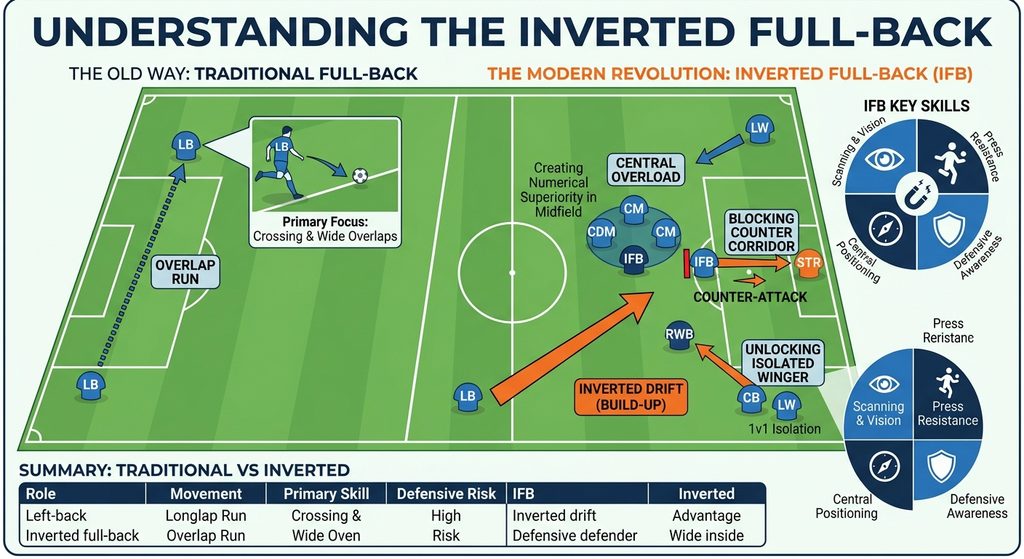
For nearly a century, the full-back was football’s most predictable archetype. Bound tightly to the touchline, their responsibilities were clear and linear: shut down the opposition winger, overlap their own wide forward, deliver crosses into the box, and track back.
Read more: The Inverted Full-BackToday, the touchline is no longer a full-back’s boundary—it is merely a starting position.
The rise of the inverted full-back has fundamentally altered the geometry, build-up mechanics, and defensive structures of modern football. By stepping inside to operate as a central midfielder during possession, full-backs have evolved from auxiliary runners on the edge of the pitch into the strategic heart of elite team structures.
1. The Roots: From Cruyff to Pep’s Paradigm Shift
While the term feels distinctly modern, the tactical DNA traces back decades. Johan Cruyff pioneered early iterations with his “Dream Team” at Barcelona in the 1890s, tasking wide defenders like Albert Ferrer or Sergi Barjuán with drifting into central spaces to support his 3-4-3 diamond system.
However, the modern explosion of the inverted full-back belongs to Pep Guardiola .
Guardiola first popularized the concept on a global scale at Bayern Munich . Blessed with Philipp Lahm and David Alaba —two defenders possessing elite technical capability and spatial intelligence—Guardiola instructed them to tuck inside alongside the single pivot during build-up play.
Later at Manchester City, Guardiola refined this into an essential blueprint. Through players like Oleksandr Zinchenko , João Cancelo , Rico Lewis , and eventually central defenders like John Stones stepping into midfield roles, the inverted movement became the default standard for dominating possession
2. Why Managers Invert: The Three Strategic Advantages
Why pull a wide player into the chaotic center of the pitch? The decision provides three major tactical advantages:
A. Central Overloads and Numerical Superiority
Modern press-heavy systems rely on covering central passing lanes. When a full-back steps into central midfield, it creates an unexpected$+1$numerical overload.An opponent pressing with two central midfielders is suddenly forced to deal with three or four, opening up passing angles to break through the opposition’s first two pressing lines.
B. Unlocking the “Half-Spaces” and Wingers
When a full-back moves inside, it forces the opposing winger or midfielder to make a difficult choice:
- Follow the full-back inside, leaving the touchline wide open for an isolated 1v1 winger.
- Stay wide, allowing the inverted full-back free reign to receive the ball on the turn in central space.
This dynamic allowed wingers like Bernardo Silva , Bukayo Saka , or Lamine Yamal to stay high and wide, receiving passes in 1-on-1 isolation with space to drive into.
C. Rest Defense & Stopping Counter Attacks
The underappreciated genius of the inverted full-back is defensive. Traditional overlapping full-backs leave 50 yards of vacant space behind them when caught high up the pitch. In contrast, an inverted full-back sits centrally alongside the defensive midfielder.
If the team loses possession, the inverted full-back is already positioned in the central corridor—allowing the team to counter-press immediately , block central counter-attacks, and force transitions wide.
3. Profiles of the Masterclass Inverted Full-Backs
| Player | Club / Context | Primary Style & Function |
| Philipp Lahm | Bayern Munich | The Tactical Blueprint: Flawless scanning, press resistance, and positional discipline. |
| João Cancelo | Man City / Barcelona | The Playmaker: Functioned as a deep-lying playmaker, carving open defenses with trivelas and incisive passes. |
| Trent Alexander-Arnold | Liverpool | The Quarterback: Shifted from right-back into a central midfield position to dictate tempo with unmatched long-range passing. |
| Oleksandr Zinchenko | Arsenal / Man City | The Connector: Used his youth background as an attacking midfielder to smooth out build-up play and control possession tempo. |
4. The Future: From Innovation to Baseline Requirement
What began as an avant-garde tactic by elite possession managers has become a standard tactical element taught in academies worldwide. Managers across top leagues—from Mikel Arteta at Arsenal to Ange Postecoglou at Tottenham—regularly utilize inverted full-backs to establish tactical control.
The modern full-back can no longer rely purely on athletic stamina and crossing ability.
They must possess the vision of a central midfielder, the press-resistance of a pivot, and the 1v1 defensive instincts of a classical full-back.
The touchline is no longer a cage—it is merely the launchpad for football’s most versatile hybrid role.
About The Author